

AI adoption across engineering, environmental consulting, and technical reporting is accelerating. Firms producing Phase I ESAs, property condition assessments, geotechnical investigations, and related deliverables are actively exploring how AI can improve efficiency, reduce repetitive work, and keep teams ahead of rising project volume.
At the same time, skepticism remains high. (And for good reason.)
KEY TAKEAWAYS
- Generic AI predicts language patterns. Technical reporting demands traceable, defensible answers grounded in source material.
- Keyword search finds words. It does not understand what those words mean within the context of a report.
- Context keys are machine-readable values that capture what a report found, not just the words it used. They make an archive filterable the way an engineer thinks: by location, conditions, and findings.
- The payoff is a two-step workflow: search narrows the archive to the right reports, then chat mines those reports for the findings, data, and language you need, with answers cited to the source.
Technical reporting is fundamentally different from the workflows most AI tools were built for. These reports carry regulatory, financial, legal, and professional weight. They are expected to be accurate, traceable, and defensible. A confident-sounding answer is not enough if it cannot be tied back to reliable source material.
That is where many generic AI systems begin to break down.
The problem isn’t intelligence, it’s context.
Most general-purpose AI platforms are designed to predict language patterns. They generate text that sounds plausible. Technical reporting requires more than plausibility.
A Phase I ESA is not a collection of paragraphs about environmental conditions. It contains a chain that runs from historical use, to suspected release mechanism, to contaminant pathway, to a recognized environmental condition determination. A geotechnical report is not narrative text about soils. It captures relationships between subsurface conditions, groundwater observations, structural loading assumptions, and foundation recommendations.
Without understanding these relationships, AI systems are limited to pattern matching. That creates a problem engineering and environmental firms already recognize: hallucination risk.
In technical consulting, hallucinations are not just inconvenient. They create liability exposure.
This concern shows up across the industry. In Quire’s Q1 MarketWatch survey, firms identified accuracy, reliability, and professional liability as the leading concerns surrounding AI adoption in technical reporting workflows. That caution is justified. Generic AI trained on open internet content was never designed for workflows governed by standards like ASTM E1527-21, or for disciplines where conclusions must be supported by traceable precedent.
Why keyword search isn’t strong enough
Many firms already know that traditional document search falls short.
Searching folders or PDFs for terms like “UST,” “REC,” or “Phase II recommendation” may technically return results, but it rarely returns meaningful context. The same terminology appears across hundreds of reports with entirely different implications depending on the site, geography, historical use, or environmental conditions involved.
Worse, the right precedent often does not use the words a current professional would search for. Consider how three reports across two decades describe the same subsurface condition. A 2005 report calls it “auger refusal at 22 feet on weathered gneiss.” A 2015 report tabulates “practical refusal in highly weathered metamorphic bedrock.” A 2023 report flags “refusal at depth on weathered rock.” A keyword search catches one phrasing and misses the others. The most relevant precedent stays invisible because the wording moved.
The same problem shows up in environmental work. One report calls it “former service station with abandoned tanks.” Another tabulates “petroleum USTs, no closure language on file.” A third flags “former fueling, recognized environmental condition, Phase II recommended.” All three describe the situation an environmental professional is trying to find. A keyword search returns a fraction of them.
This is the difference between search and understanding. Most systems can locate words. Very few understand what those words mean within the context of a report. The professionals using these reports rarely need a word. They need an answer to a contextual question.
The missing layer: context keys
This is where context keys become critical.
Context keys are machine-readable values that capture what reports actually found, not just the words inside them. Instead of leaving a report as freeform text, the system extracts structured values that describe its conditions and findings: tanks present or absent, groundwater at a given depth, a property’s type and location, a recognized environmental condition determination. These values let a system interpret technical documents the way engineering workflows do.
A useful analogy is a spreadsheet. Without structure, reports behave like disconnected blocks of text. Context keys let reports function more like rows and columns, with identifiable attributes that can be filtered, sorted, and compared. A search for properties with no tanks, or groundwater between 5 and 15 feet, becomes a precise query instead of a guess at phrasing.
This is also what separates search from understanding in practice. A keyword tool can locate the letters “REC” in a document. A context key records that the report reached a recognized environmental condition determination, which is the thing a professional is actually looking for.
How context keys work in search and chat
Context keys power a simple two-step workflow. First, search uses structured values to narrow the archive to the most relevant prior reports. Then, chat lets a professional ask questions of those specific reports to mine the findings, data, and language they need. The distinction matters: search finds the right reports, and chat interrogates them.
Here is how that plays out across real workflows:
Use Case #1
Finding comparable sites, then asking what happened
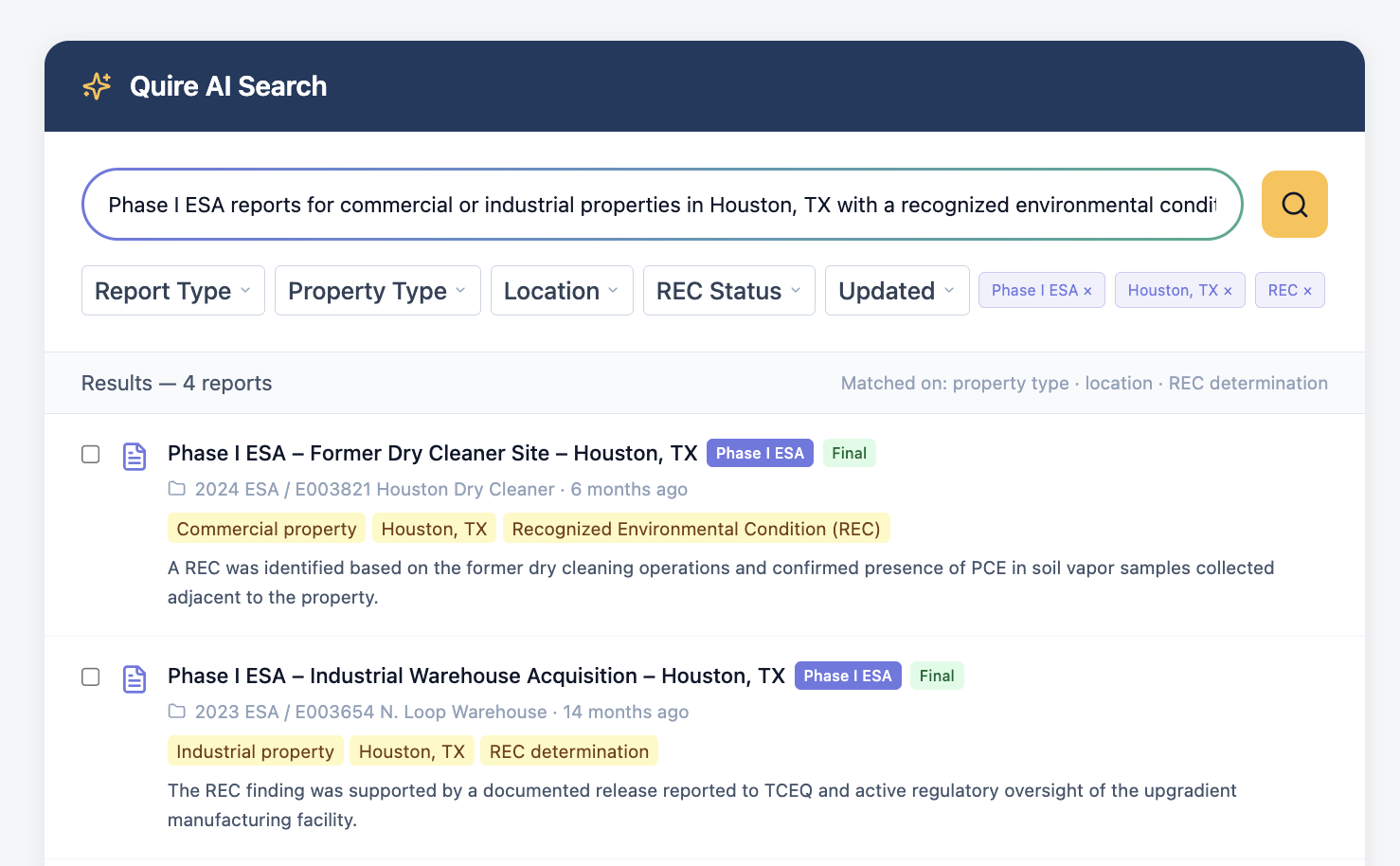
Say an environmental professional scoping a new Phase I on a former gas station wants to see how the firm has handled similar petroleum sites before. They search for prior Phase I ESA reports of the same property type, in the same state, that reached a recognized environmental condition determination.
Those criteria map directly to context keys, so the system returns the handful of truly comparable reports rather than every document that happens to mention the term.
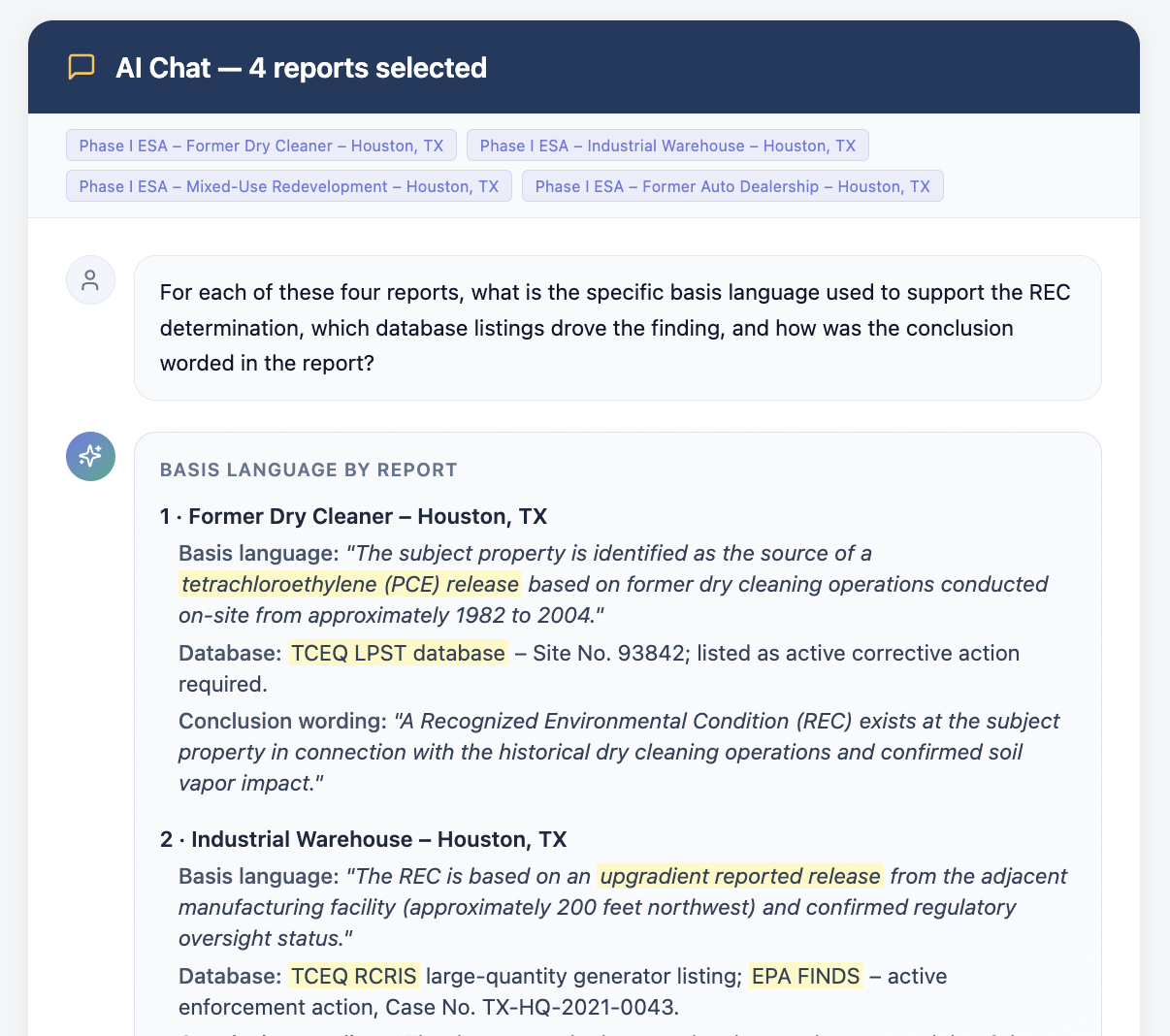
With those reports in hand, they chat to mine them: what basis language supported each REC determination, which database listings drove it, how the conclusion was worded. That is the chat layer interrogating the reports search surfaced, not a filter on a context key.
Use Case #2
Searching by location, then comparing conditions
Geolocation context keys derive latitude and longitude from a report’s address, which makes proximity a searchable value. A geotechnical engineer can search for prior reports within a defined radius of a new site, then chat with those reports to compare subsurface conditions, review how foundations were approached nearby, and reuse language that fits the local geology. The search narrows by distance and report type. The chat does the engineering comparison.
Use Case #3
Isolating the feature that drives a determination
Search can narrow to reports that share a structured characteristic, such as industrial or warehouse properties in a given area. From there, chat does the interpretive work: which site features most often drove a concern, how vapor intrusion potential was framed, what distance and gradient logic was applied. A warehouse can be low risk. A warehouse with maintenance bays and solvent storage is a different profile, and that distinction lives in how the report reasoned, which is exactly what the chat layer surfaces.
Use Case #4
Building reusable, defensible language
Once search has assembled a set of comparable reports, chat becomes a way to extract validated, firm-authored language: how a hydrogeologic setting was described, how a data gap was explained, how a Phase II scope was justified. Professionals use this to keep findings consistent and to avoid drafting proven sections from scratch. The work product the firm already trusts becomes a source of reusable language rather than a static archive.
In every one of these cases, the system is not improvising. Search retrieves on structured engineering context, and chat grounds its answers in documents the firm already trusts.
Why this matters for reliability
The primary value of context keys is not convenience. It is precision.
Hallucination risk rises when systems lack grounding and contextual structure. By organizing technical reports into identifiable, machine-readable values, context keys help reduce that risk and improve the relevance of both search and conversational retrieval.
That distinction matters because technical firms are not looking for AI that improvises. They want AI that helps them:
- Find relevant precedent faster
- Surface consistent conclusions
- Retrieve validated language
- Compare similar historical conditions
- Support defensible decision-making
Every answer is grounded in source documents and traced back with citations, so results are verifiable rather than invented. As the technology develops, relevancy scoring is being added to give professionals a clearer signal of how closely a retrieved report matches the question at hand. The direction is consistent: strengthen professional judgment rather than replace it.
What engineering and environmental firms actually need from AI
The firms seeing the most value from AI are generally not using it to write reports from scratch. They use it to reduce friction around retrieval, comparison, and workflow consistency.
This aligns directly with Quire’s Q1 MarketWatch findings, where firms expressed the highest interest in intelligent QA and error flagging, automated data extraction, leveraging prior reports and wordbanks, and AI-powered historical search.
The pattern is clear. Firms trust AI most when it is grounded in their own verified historical work product, not disconnected public information.
The pattern is clear. Firms trust AI most when it is grounded in their own verified historical work product rather than disconnected public information.
Why this changes the role of historical reports
Most environmental and engineering firms already hold enormous institutional knowledge. Years of Phase I ESAs, PCAs, and geotechnical investigations contain valuable conclusions, observations, and precedent. The challenge has always been retrieval. Can teams actually find and apply that knowledge efficiently?
Context keys change the equation. They transform static report archives into structured, searchable knowledge systems. Instead of relying on memory, folder navigation, or manual review, teams retrieve relevant prior work based on actual engineering context, then chat with those reports to apply what they find. That changes how firms scale expertise, train staff, maintain consistency, and defend their conclusions. Newer staff can query the archive directly and see the firm’s actual decision pattern across comparable projects, instead of waiting for a senior colleague to be free.
Quire Lazarus: AI Designed for the Work You Do
Generic AI struggles in technical reporting because technical reporting is fundamentally contextual.
Engineering and environmental deliverables are not generic documents. They are structured evaluations built on standards, precedent, interpretation, and defensible judgment. Systems that fail to understand that context will always struggle to produce reliable outcomes.
This is what Lazarus, Quire’s AI-powered institutional knowledge layer, is built to do. By combining engineering-grade search with context keys that structure historical report data, Lazarus helps firms find the most relevant prior reports and then chat with them to mine findings, data, and language with precision and traceability. Instead of treating technical reports as unstructured text, it understands them as technical work products with meaning.