
Artificial intelligence has quickly become a major part of the conversation across engineering, environmental consulting, and technical reporting. Yet much of that conversation remains centered on one narrow promise: faster writing.
Generate a summary. Draft a section. Produce a first pass in seconds.
Those capabilities are useful, but they do not address the most significant constraints facing firms that produce Phase I ESAs, Property Condition Assessments, geotechnical investigations, and other technical deliverables.
For most firms, the real bottleneck is not writing the report. It is finding the right historical information before and during the draft: locating comparable projects, reviewing prior conclusions, confirming consistency, and identifying language that reflects the firm’s established judgment.
In technical consulting, the greatest value of AI is not its ability to create more words. It is its ability to make years of existing work more accessible and useful.
Key Takeaways
- The bottleneck in technical reporting is access, not authorship. Much of the effort occurs before the draft, when teams search for prior work, compare interpretations, and locate approved language.
- Faster writing does not improve the work if the underlying information remains difficult to reach. In regulated and liability-sensitive disciplines, quality depends on the strength of the information and precedent supporting the conclusion.
- The most valuable AI capabilities in technical reporting are search, retrieval, comparison, and traceability across the work a firm has already produced.
- When historical reports become searchable, firms can improve consistency, accelerate staff development, and increase delivery capacity without adding headcount at the same rate.
The Work Happens Before The Draft
A substantial share of technical reporting work takes place before a section is written.
Teams must identify comparable engagements, review historical findings, understand how similar conditions were interpreted, and locate language that aligns with firm standards. Each new assignment benefits from knowing what the firm has encountered before and how it responded.
For a Phase I ESA, that may mean reviewing prior reports involving petroleum operations, dry cleaners, rail corridors, industrial adjacency, or similar historical land uses. For a PCA, it may involve comparing recommendations for roofing systems, façades, HVAC equipment, or reserve assumptions across comparable properties. In geotechnical work, engineers may look for nearby projects with similar subsurface conditions, groundwater observations, foundation recommendations, or slope stability concerns.
The intelligence exists. The problem is how it is stored.
Most firms retain this history in PDFs distributed across network folders, project directories, and disconnected repositories. Reports may be organized by client, project number, location, or date, but rarely by the specific finding, condition, or judgment a team needs to locate.
Faster Writing Does Not Solve the Hard Part
Technical firms do not succeed because they produce paragraphs quickly. They succeed because they apply sound judgment consistently, support conclusions with evidence, and deliver reliable work under deadline.
That distinction is especially important in regulated and liability-sensitive disciplines. The ASTM E1527-21 framework for Phase I ESAs emphasizes historical sources, prior investigations, interviews, and reasonably ascertainable information when evaluating environmental conditions. The quality of the assessment depends on how effectively the professional gathers and interprets relevant evidence, not how quickly the narrative is drafted.
The same principle applies in geotechnical and building assessment work. Recommendations are expected to reflect local conditions, prior experience, and comparable project history. A polished paragraph has limited value if the reasoning behind it cannot be supported.
AI is therefore most useful when it strengthens the work beneath the writing.
What AI Should Actually Do With Your Reports
The most practical applications of AI in technical reporting fall into four categories: search, retrieval, comparison, and traceability.
Search
Teams should be able to search by meaning, not just by filename or folder structure. That might include Phase I ESAs involving former fueling operations in a particular market, PCA reports with roof replacement findings across suburban office portfolios, or geotechnical reports near a target site with shallow groundwater.
Retrieval
Professionals rarely need an entire 200-page report. They need the section discussing recognized environmental conditions, the reserve table associated with a building system, or the foundation recommendation tied to a specific soil profile.
Comparison
When several comparable projects reached similar conclusions, that consistency is meaningful. When they did not, the differences may be equally important. AI can expose patterns and discrepancies that would otherwise remain buried across separate documents.
Traceability
In work where defensibility matters, teams benefit from connecting recommendations to documented precedent rather than relying only on memory, informal knowledge, or an unverified generated response.
Searchable Precedent Expands Capacity
The operational impact extends beyond time saved.
When teams can retrieve relevant prior work quickly, they spend less time searching and more time applying professional judgment. Reviewers gain more consistent access to the firm’s established approaches across offices and project teams. New hires can learn from actual prior engagements rather than depending entirely on the availability of senior staff.
That changes the role of experienced professionals as well. Instead of repeatedly pointing teams toward old projects or answering the same foundational questions, they can focus more of their time on interpretation, exceptions, and high-value decisions.
This also creates a different path to growth. Firms often respond to rising demand by increasing headcount, even when part of the delivery constraint is caused by inaccessible knowledge. Making historical work usable in real time allows existing expertise to support more projects, more consistently, without requiring staffing to grow at the same rate.
Your Firm’s Archive, Finally Searchable
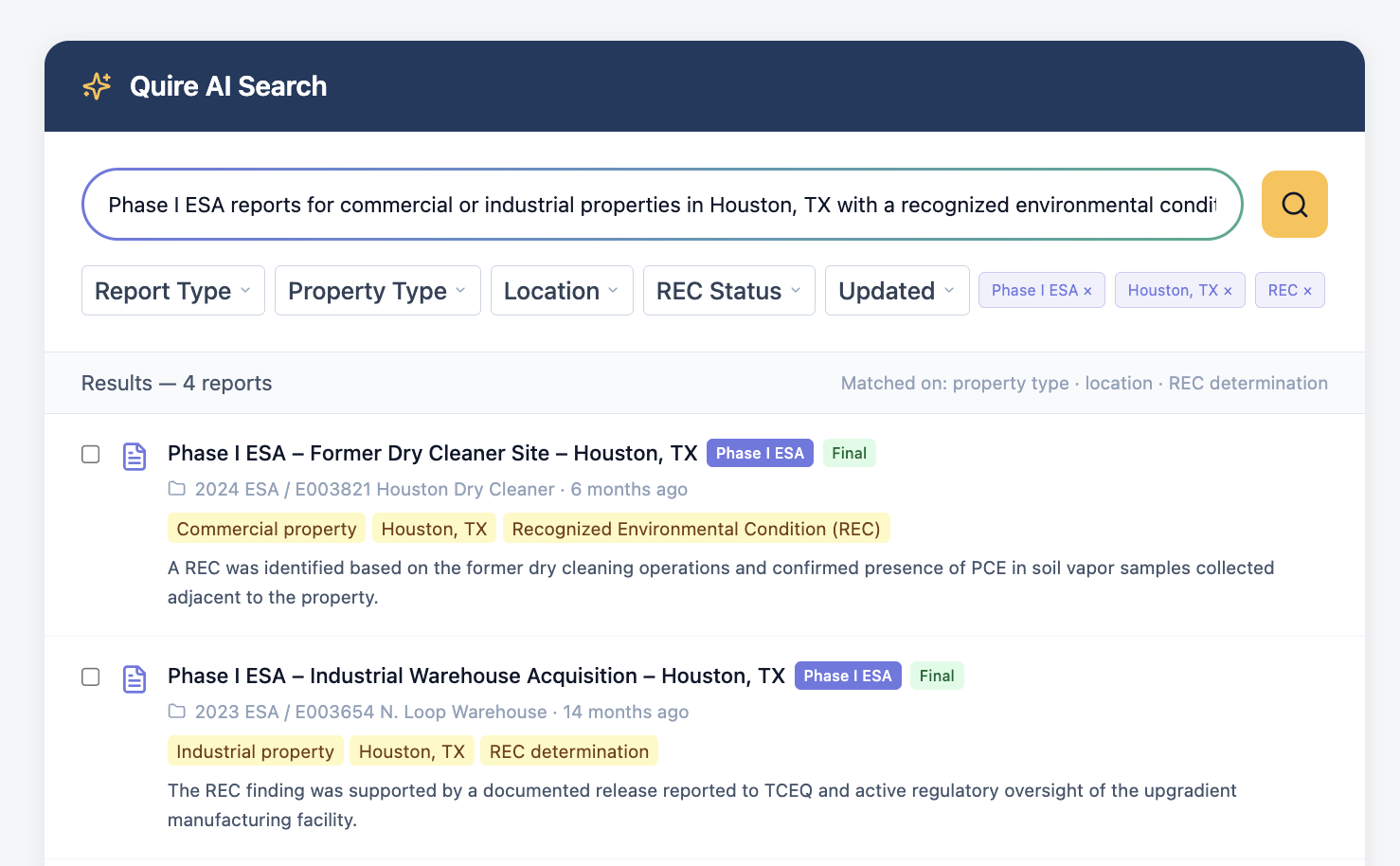
The challenge is not that firms lack institutional knowledge. It is that much of that knowledge remains trapped in documents that were never designed to function as an accessible body of intelligence.
Quire is built to change that. As a Technical Report Management™ platform, it brings AI-powered search and chat to the reports firms produce within Quire today. Lazarus extends those capabilities across the work that came before, indexing legacy Phase I ESAs, PCAs, geotechnical reports, and other technical deliverables so they can be searched and queried alongside current work.
The result is not simply a more convenient archive. It is a different way of working with the firm’s accumulated experience.
An environmental professional can surface prior reports involving UST/LUST proximity, PFAS considerations, or industrial corridor risk without knowing which project contained the relevant analysis. A PCA team can identify recurring building-system findings across a portfolio. A geotechnical engineer can locate nearby projects with comparable soil conditions, groundwater observations, or foundation recommendations.
In each case, the archive becomes more than a record of completed work. It becomes an active source of precedent during the next assignment.
That distinction matters. A firm’s historical reports contain years of observations, interpretations, recommendations, and professional judgment across thousands of projects. Stored as static PDFs, that knowledge remains difficult to apply at the moment it is needed. Made searchable, it becomes part of the firm’s operating infrastructure.
The firms that gain the most from AI will not necessarily be those that generate the most content. They will be the ones that can bring the full weight of their own experience to every new project.
Frequently Asked Questions
What can AI actually do for technical reporting beyond writing?
The most practical applications are search, retrieval, comparison, and traceability across a firm’s historical work. AI can locate comparable past projects, retrieve the specific section or table that matters, reveal patterns or inconsistencies across prior conclusions, and connect recommendations to documented precedent. Faster drafting is only one small part of the opportunity.
What is the difference between Quire and Lazarus?
Quire is the Technical Report Management™ platform, with AI-powered search and chat built into the work a firm produces within it. Lazarus is an optional add-on that indexes reports created before the firm adopted Quire, bringing legacy Phase I ESAs, PCAs, geotechnical reports, and other deliverables into the same searchable environment as current work.
Do firms need to reformat old reports to make them searchable?
No. Lazarus is designed to index reports as they already exist, including PDFs stored in network folders. Firms do not need to reorganize or manually restructure their archives before their teams can begin searching them.
How does searchable precedent help newer engineers?
It gives newer professionals direct access to relevant examples from the firm’s own work. They can see how similar conditions were evaluated, how conclusions were supported, and how recommendations were communicated without depending entirely on a senior colleague to point them toward the right project. This accelerates learning while reducing repetitive demands on experienced staff.
Put your best work back to work
Quire manages the reports your firm produces today. Lazarus makes the decades you have already written searchable alongside them, so every new project can begin with the knowledge your firm has already earned.