
Key takeaways from Quire’s panel discussion on automation, expertise, liability, and the future of technical report workflows
AI is no longer a far-off conversation for due diligence. It is already influencing how firms think about staffing, pricing, client expectations, quality control, and the role of technical professionals in a faster, more automated industry.
But the most useful question is not simply whether AI will affect ESAs, PCAs, and technical reporting. It already is.
The better question is: What happens when AI becomes good enough to change the underlying economics of due diligence?
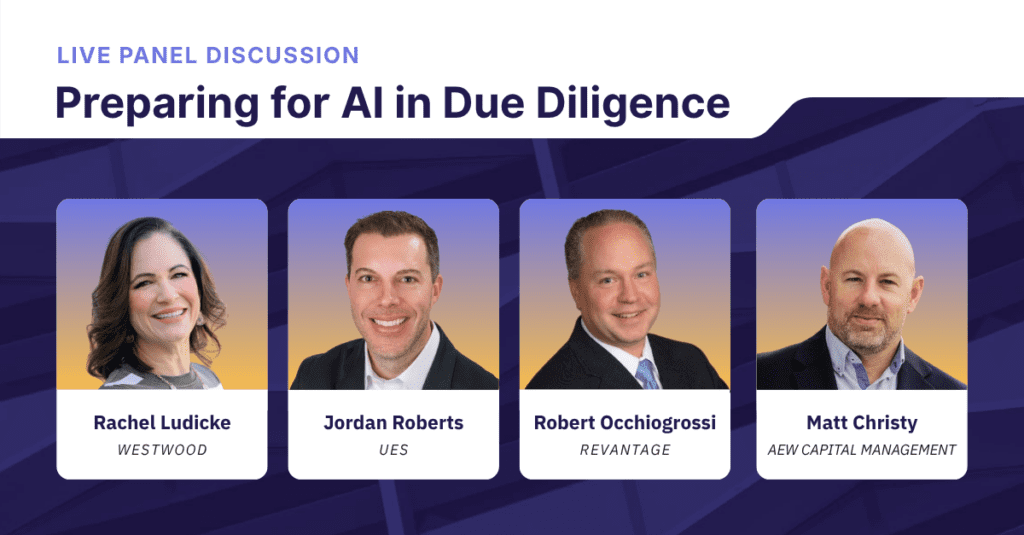
That was the thought experiment behind Quire’s recent panel discussion, moderated by Kelly Stratton, Founder and President of Quire. The panel brought together Rachel Ludicke of Westwood Professional Services, Jordan Roberts, P.E. of UES, Robert Occhiogrossi of Revantage, and Matt Christy, P.E. of AEW to explore a hypothetical future where ESAs and PCAs can be delivered in under 72 hours, with data collection, records research, analysis, and report assembly largely automated.
In that scenario, environmental professionals and PCA consultants still review, validate, and sign off, but the work required to produce the report looks fundamentally different.
Kelly framed the conversation as a planning exercise akin to business continuity planning, not a prediction exercise. The point was not to debate whether the scenario would happen, but to ask what the business looks like from inside that future. As she put it:
“When turnaround compresses by 80% and labor input drops by 90%, you don’t just have faster reports. You actually have a different industry.”
1. AI may split the market between commodity reports and deeper advisory work
One of the clearest takeaways from the panel was that AI will not affect every kind of due diligence work the same way.
For more commoditized work, especially reports produced to satisfy lower-tier lender requirements, the panelists expected pricing pressure. The basic, check-the-box version of due diligence may become faster, cheaper, and more standardized as automation improves.
Jordan Roberts described the PCA market as already having two distinct categories:
“The PCA industry has really sort of divided itself into two types of products. One is sort of a check-the-box, satisfy-the-lender report. The other one is a more in-depth analysis of an entity that really wants to understand the facility.”
That distinction matters because AI does not necessarily reduce the value of every report. It changes where the value sits.
The tedious work of writing, assembly, and repetitive documentation may compress. But judgment, client-specific risk understanding, and advisory interpretation may become more important.
“The more tedious tasks of writing are easily replaced. The judgment, the client relationship, and the understanding of what your client’s risks and needs are going to be more pronounced.”
What this means
Commodity work may get squeezed
Basic reports may become faster, cheaper, and more standardized. The panel discussed whether firms built primarily around high-volume, low-touch production may feel the greatest pricing pressure.
Advisory work becomes more valuable
Clients will still need humans who can interpret findings, understand risk tolerance, and translate technical information into investment decisions.
Positioning gets sharper
Firms may need to decide whether they are competing on speed and volume or depth and specialization. As Jordan put it, the market may force firms to choose between being “the Walmart of due diligence reports” or “the Main Street shop.”
2. The workforce does not disappear, but the skill set changes
The panel did not treat AI as a simple replacement for technical professionals. The more nuanced view was that automation shifts what people spend time doing.
If AI can reduce the hours spent drafting, formatting, searching, and assembling reports, professionals can spend more time reviewing, questioning, interpreting, and advising.
That shift makes critical thinking more valuable, not less.
“Definitely critical thinking,” Rachel Ludicke said. “The AI might take away some of the more tedious tasks, freeing us up for higher thought, for critical thinking, for that further decision-making that needs to happen.”
This matters because the industry is already under workforce pressure. Rachel noted that there are fewer young professionals entering the pipeline, which makes it even more important to use technology to remove work that does not require the highest level of human judgment.
Jordan made a similar point from the PCA side. AI may reduce time spent writing, but that does not eliminate the need for experience. It changes how experience is gained and applied.
“Less time writing, more time understanding building systems and talking about solutions.”
The training model may change as a result. Entry-level professionals may spend less time grinding through repetitive first drafts and more time learning how to review AI-generated work, identify false assumptions, understand client risk, and compare technical conclusions against real-world conditions.
Matt Christy framed that as a potential upside:
“The newer folks in the industry are getting more reps than their predecessor had at their age. They’re seeing more deals, they’re seeing more reports, they’re seeing more risks and how they’re solved.”
Potential future implications
Training shifts from drafting to review
Firms will need to teach younger professionals how to challenge AI output, not just produce first drafts.
Critical inquiry becomes essential
Knowing what to question, where AI may be wrong, and what a client actually needs becomes a core professional skill.
More exposure may accelerate development
If professionals can review more reports and more risk scenarios earlier in their careers, AI may help create a stronger next generation of technical leaders.
3. Liability does not go away. Human accountability may matter even more.
Automation does not eliminate responsibility.
If anything, AI may make accountability more visible because the industry will need to define who owns the output, who validates the work, and who is responsible when something goes wrong.
Robert Occhiogrossi put it plainly:
“There still needs to be ownership and responsibility that goes with whatever’s produced.”
That point matters because due diligence is not a low-stakes writing exercise. ESAs, PCAs, and related reports inform investment decisions, risk management, regulatory obligations, and professional liability. A report may be faster to produce, but it still has to be defensible.
From the buyer side, Matt was clear that he would still expect a qualified human to be tied to the final report.
“I don’t think the standard’s going to write out humans. I think humans are still going to be the EP, the PE, or the LSP, and are still going to be involved—and are ultimately the ones putting their stamp or signature on the report.”
Rachel’s perspective as an environmental professional made the personal weight of that responsibility clear. If the EP becomes one of the only humans deeply involved in the final review, signing may feel even heavier.
“As potentially the only human involved in this process, it is your throat that gets choked as the EP.”
The liability conversation also raised a second issue: data privacy.
Sensitive project information cannot simply be pushed into any AI environment without considering where that data goes and who can access it. Some clients already restrict AI-generated or AI-assisted content, or require disclosure when AI is used.
Potential future implications
Human signoff remains central
AI may draft, assemble, summarize, or compare. But the market will still expect a responsible professional to validate the work.
Contracts will likely evolve
Buyers may demand clearer language around AI use, human review, source data, and responsibility.
Secure environments become non-negotiable
The question will not only be “Does the AI work?” It will also be “Where does the data go, who can access it, and can we defend how it was used?”
4. Faster due diligence could change how deals are evaluated, sequenced, and closed
A 72-hour report does not simply mean the same transaction moves faster. It could change when and how due diligence happens in the deal process.
Matt described the investor-side objective as identifying risks quickly, understanding them, quantifying them, accepting them, and closing the transaction. If reports can be generated accurately in days instead of weeks, the diligence timeline may shift much earlier in the investment process.
“There’s a real possibility it flips the diligence timeframe in the investment process.”
That could unlock entirely new workflows. Investors may be able to screen more assets, evaluate portfolios earlier, run preliminary diligence before a traditional transaction process begins, or use fast assessments to pursue off-market opportunities with better risk visibility.
Matt connected faster due diligence directly to capital deployment:
“I think it’ll lead to certainly more transactions. I think you’re going to be able to do more transactions, deploy capital faster, and it’s also going to be, dare I say, smarter capital.”
Jordan raised another possibility: faster and less expensive assessments may expand the overall market. Today, some deals happen without a PCA or ESA because of cost, timing, or risk tolerance. If a basic assessment becomes more accessible, more buyers may choose to order one.
The report itself may also evolve. Jordan suggested that, with more automated data collection and entry, a PCA could eventually become less of a one-time snapshot and more of a continuous product connected to building management and financial systems.
That is a much bigger shift than faster PDFs. It points to a future where due diligence becomes part of a broader intelligence layer around assets, portfolios, operations, and capital planning.
Potential future implications
Due diligence may move earlier
Fast, automated first-pass reports could become a screening mechanism before deeper investigation begins.
More reports may be ordered, not fewer
If assessments become more accessible, the total market may expand as more deals include some level of diligence.
Reports may become living intelligence
The future may not be limited to static deliverables. It may include ongoing asset intelligence that supports acquisitions, asset management, and capital planning.
5. The firms that adapt fastest will have the advantage
The panel closed with a simple but important message: waiting is not a strategy.
Robert encouraged firms to treat AI as a tool, but one that requires clear understanding of source data and limitations.
“AI is a tool. You need to know the source limitations for the data that’s being pulled in, and really just think big about the possibilities.”
Matt compared AI’s potential impact on real estate to automation in manufacturing, where technology expanded what could be produced and at what scale. He acknowledged the transition may be uneven, but argued that the long-term result could be positive for the built environment.
Jordan put the adaptation challenge in broader terms:
“It’s not the strong that survive. It’s those who can adapt the best to change.”
Rachel’s closing thought was even more direct:
“Never bet against technology.”
Kelly’s own closing point brought the conversation back to the stakes of technical reporting. In industries where “probably right is wrong” and accuracy truly matters, general-purpose AI tools are unlikely to be enough.
“General-purpose AI tools are not going to serve you well. So definitely proceed with caution and lean more toward something that’s more purpose-built.”
Potential future implications
AI strategy needs to start now
Firms do not need to have every answer, but they do need a point of view on how AI fits into their workflows, risk tolerance, and client commitments.
Purpose-built matters
Technical reporting is not generic knowledge work. Accuracy, context, traceability, and defensibility are too important for one-size-fits-all tools.
Adaptability becomes a competitive advantage
The firms that win will not necessarily be the biggest or the most aggressive. They will be the ones that learn how to apply AI thoughtfully, securely, and effectively.
What Firms Can Do Now
The future of AI in due diligence is not just about faster report generation. It is about better access to context, stronger precedent, more consistent review, and the ability to preserve technical expertise in a way that scales across the organization.
That is the work Quire is focused on today.
Quire AI Search & Chat helps technical teams search and interact with the work already living inside Quire. Lazarus extends that intelligence to historical PDFs and legacy report archives, helping firms turn years of completed work into searchable, usable institutional knowledge.
For due diligence teams, that means AI can support practical workflows now: finding similar past projects, surfacing proven language, comparing findings across reports, preserving institutional knowledge, and giving reviewers better context before decisions are made.
The goal is not to replace the professional judgment that makes ESAs, PCAs, and technical reports valuable.
It is to make that judgment easier to find, easier to apply, and easier to carry forward.
Because if the panelists were right, the firms best prepared for the future will not be the ones waiting to see what happens.
They will be the ones planning from inside the change before it fully arrives.